Tuolumne County Will Lose Without CAL FIRE
Before Tuolumne County Gives Up CAL FIRE, Residents Deserve to Know What We Would Really Lose
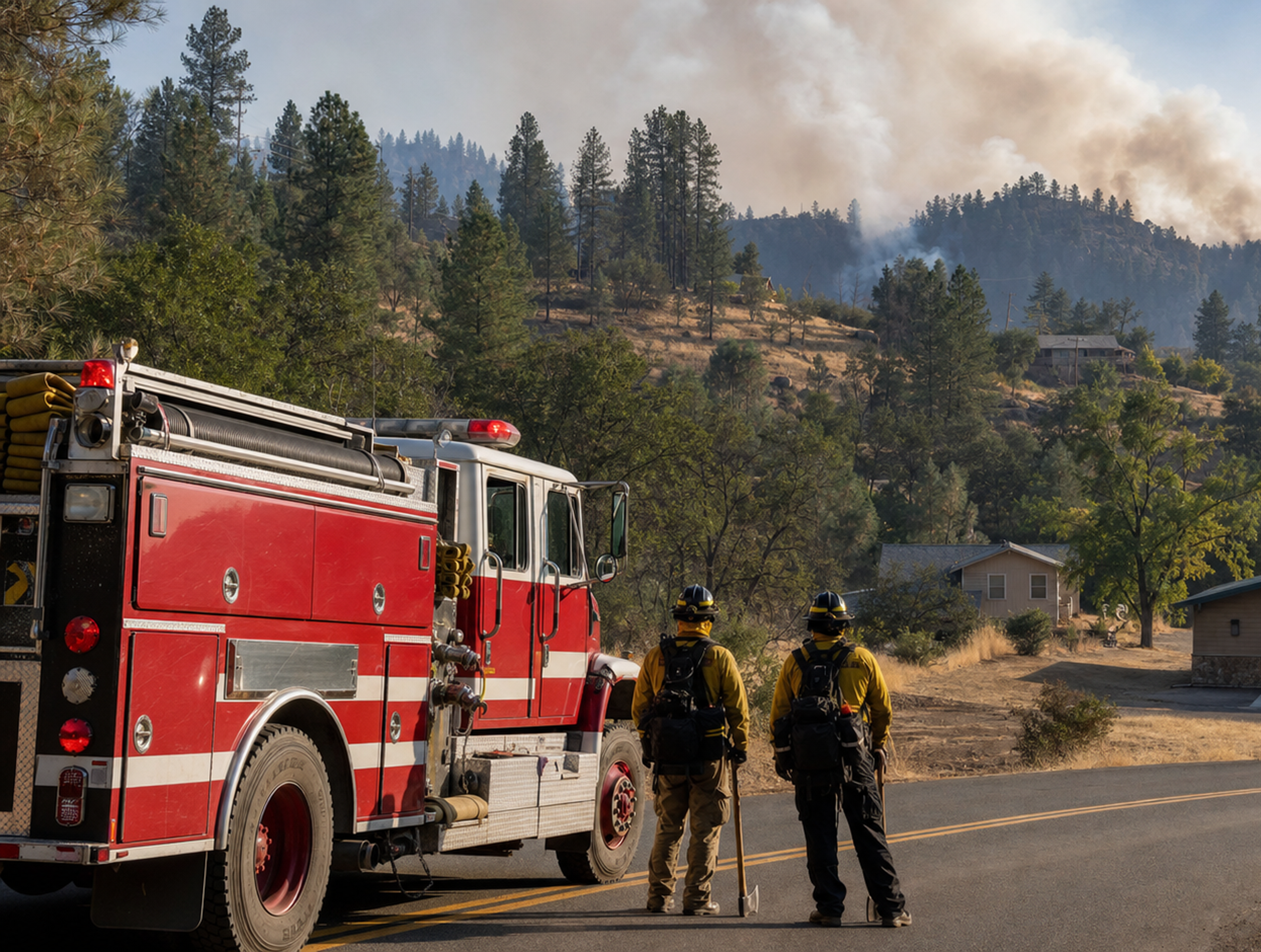
Replacing a decades-old public partnership with a private fire contractor would not be a simple change of uniforms. It could transfer enormous operational, financial and legal risks back to Tuolumne County, and ultimately to its taxpayers.
When most of us see a fire engine marked “Tuolumne County Fire,” we understandably assume the people aboard it are county employees working for an entirely county-operated department.
That is not how our system works.
Tuolumne County Fire Department is a county agency, but most of its career workforce is supplied and managed through cooperative agreements with the California Department of Forestry and Fire Protection, CAL FIRE. According to the county, Tuolumne County Fire is funded for 50 full-time-equivalent positions. Of those, 44.5 are provided through the CAL FIRE cooperative agreement, the Amador program and related agreements. Only 5.5 are county-employed positions.
Those CAL FIRE-supported positions include engine crews, an assistant chief, a battalion chief, training and safety captains, emergency-command-center staffing, a heavy-equipment mechanic and administrative support. The system serves more than 2,200 square miles and approximately 55,000 residents, not counting the hundreds and hundreds of thousands of people who visit our county each year.
In 2025, Tuolumne County Fire handled 6,843 incidents, including 4,778 medical calls and 527 fires. Call volume was more than 32% higher than it had been ten years earlier. These figures come directly from the county’s description of the department and should frame every discussion about its future: this is not a small rural service responding mainly to an occasional vegetation fire. It is an all-risk emergency-response system operating every day of the year. (Tuolumne County Fire Department)
The question, therefore, is not simply whether a private company could put firefighters in stations for a lower advertised price. The real question is whether a private provider could replace the entire system Tuolumne County currently receives from CAL FIRE, and whether the county could absorb the risks and hidden expenses that would return to local taxpayers.
Our CAL FIRE agreement is not “privatization”
The present arrangement is a government-to-government cooperative agreement. CAL FIRE is a public fire agency staffed by public employees, subject to public-sector training, safety, accountability and mutual-aid systems.
CAL FIRE reports that it administers more than 100 cooperative fire-protection agreements across 31 California counties, along with numerous cities, districts and service areas. Through these agreements, communities receive various combinations of structural firefighting, emergency medical response, rescue, hazardous-material response, dispatch and wildland protection. (CAL FIRE Cooperative Efforts)
A private contract would be fundamentally different. The county would be purchasing emergency services from a company whose responsibilities, staffing and financial exposure would be limited by the precise language of its contract.
That does not mean every private provider is incapable or unsafe. It means that a proposed price has no meaning until the public knows exactly what is included, what is excluded and who bears the cost when something goes wrong.
We are buying far more than firefighters in fire stations
CAL FIRE gives Tuolumne County access to an established public-safety organization with statewide depth. That includes standardized command practices, training and safety programs, experienced chief officers, communications infrastructure, fleet expertise, logistics, procurement systems and the ability to operate within California’s larger emergency-response network.
Other counties describe the same value. Placer County, for example, reports that its CAL FIRE agreement provides 24-hour chief-officer coverage, fire prevention, training and safety, fleet maintenance, administration, procurement and logistics, communications and facility support. Placer County specifically describes its Amador agreement as a cost-effective way to use CAL FIRE stations and equipment when purchasing, maintaining and staffing equivalent resources locally would not be financially feasible. (Placer County staff report)
Tuolumne County’s own strategic plan describes a cooperative relationship reaching back to the early 20th century and a formal agreement dating to 1974. It credits automatic- and mutual-aid agreements with sending the appropriate available resource in the shortest time, increasing fireground staffing and strengthening preparation for major emergencies. (TCFD 2021–2025 Strategic Plan)
A private proposal must therefore be compared with the value of the whole network—not merely with the wages of the firefighters assigned to a particular station.
Workers’ compensation, disability and personnel risk do not disappear
Firefighting produces unusual occupational exposure: burns, orthopedic injuries, smoke and toxic substances, post-traumatic stress, infectious disease, hearing damage and certain cancers. California law gives public-safety employees a number of occupational-injury presumptions, and serious injuries can create years of medical, disability and administrative obligations.
Under the present structure, most of the career personnel serving Tuolumne County Fire are state employees. CAL FIRE recruits them, trains them, supervises them and administers their employment relationship. The county reimburses CAL FIRE under the agreement, so residents should not be told that personnel-related expenses are “free.” They are not.
But there is an important difference between reimbursing a large public agency for an established workforce and becoming responsible for building and managing that workforce, or relying on a private contractor whose insurance, exclusions and financial stability must be continuously monitored.
If the county employed the firefighters directly, it would need to administer payroll, labor relations, recruitment, background investigations, promotions, discipline, occupational medicine, injury claims, return-to-work programs, disability accommodation, leave, retirement and potentially long-tail workers’ compensation liabilities.
If a private contractor employed them, the county would still need to determine what happens when:
the contractor’s workers’ compensation premiums rise sharply;
a claim is denied or disputed;
an employee alleges unsafe staffing or inadequate equipment;
the contractor cannot recruit enough qualified personnel;
the contractor’s insurance contains exclusions or insufficient limits;
the contractor becomes insolvent, is sold or declines to renew;
responsibility for an injury or failed response is contested between the company and the county.
Private fire service does not eliminate these risks. It redistributes them through contracts, insurance policies and indemnification clauses. Eventually, those costs reappear as higher bids, reduced service, legal disputes or direct public liability.
California’s Office of Self-Insurance Plans notes that public agencies often form joint-powers authorities specifically to pool workers’ compensation liability. That alone illustrates the size and complexity of the exposure a stand-alone system must manage. (California Department of Industrial Relations)
Before claiming savings, the county should commission an independent actuarial analysis of workers’ compensation, disability, retirement and other post-employment liabilities over at least 10 to 20 years.
Technology and dispatch are part of the emergency response
Modern firefighting depends on far more than radios and engines. Emergency-command-center staff must track unit availability, recommend the appropriate response, coordinate multiple jurisdictions, maintain interoperable communications and move resources when simultaneous incidents occur.
Tuolumne County’s CAL FIRE-supported staffing includes positions in the San Andreas Emergency Command Center. CAL FIRE’s larger system connects local incidents with state resources and other cooperating agencies. Its cooperative program is specifically intended to bring state, federal and local resources together under coordinated command during fires and other disasters. (CAL FIRE Cooperative Efforts)
A private company could purchase dispatch software, radios and vehicle-location equipment. But equipment ownership is only the beginning. The county would need guarantees concerning system redundancy, cybersecurity, radio coverage, maintenance, data ownership, interoperability, dispatch performance, backup facilities and the qualified personnel necessary to operate everything around the clock.
Any proposed savings that exclude replacement and lifecycle costs for communications, information technology, vehicles, breathing apparatus, protective clothing, station systems and specialized equipment would be misleading.
Surge capacity matters most on the worst day
A routine medical call may require one engine. A fast-moving wildland fire threatening several communities can demand aircraft, engines, hand crews, bulldozers, strike teams, command staff, logistics, communications and days or weeks of sustained operations.
CAL FIRE remains responsible for wildland fire protection in California’s State Responsibility Areas regardless of a local Schedule A agreement. Ending the county contract would not make CAL FIRE vanish from Tuolumne County.
But the existence of CAL FIRE resources nearby is not the same as having an integrated, year-round county system staffed and managed by CAL FIRE. State resources have their own statutory responsibilities, priorities and availability. During a major regional fire siege, every aircraft, engine and crew may already be committed.
A private contractor’s obligations would be only what Tuolumne County purchased. Residents deserve to know how many reserve firefighters and engines would be guaranteed, how quickly they would arrive, whether the contractor could send local personnel elsewhere, and what happens when multiple emergencies occur at once.
“Mutual aid will cover it” is not a complete financial or operational plan. Mutual aid is strongest when every participant brings a credible initial-response force to the system.
Staffing shortages could become the county’s problem overnight
Fire departments throughout California compete for a limited pool of qualified firefighters, apparatus engineers, officers, dispatchers and mechanics. CAL FIRE can recruit and develop personnel through a statewide organization with established classifications, academies and career paths.
A private operator might initially recruit experienced personnel from the existing workforce. But Tuolumne County must evaluate retention over the full life of the contract. Pay, retirement, health coverage, disability protection, training and promotional opportunity all influence whether skilled employees remain.
A low bid based on lower compensation or leaner staffing may be inexpensive only until vacancies, mandatory overtime and turnover begin degrading service.
The contract must also address continuity. Firefighters accumulate critical local knowledge: roads, water systems, access problems, target hazards, evacuation routes and community vulnerabilities. Losing a veteran workforce and rebuilding it later could take years.
The county’s recent budget pressure is real—but so are the consequences
Tuolumne County has a genuine fire-funding problem. In January 2026, county staff projected a $1.8 million shortfall if existing service levels were maintained. Staff also warned that reducing CAL FIRE contract services would require approximately six months of preparation. (January 2026 county staff memorandum)
In April 2026, the Board of Supervisors voted 3–2 to reduce the CAL FIRE agreement by approximately $2.3 million following the expiration of federal SAFER grant funding, resulting in the closure of Mono Vista Station 56. (Board meeting report)
These are difficult fiscal realities. Ignoring them would not be responsible.
But a budget deficit does not prove that privatization will save money. It proves the county must decide what level of fire protection it expects and how it will sustainably pay for it. Cutting a station, operating a county department and hiring a private contractor are three different decisions with three different risk profiles.
What the public should demand before any privatization vote
Before ending the CAL FIRE relationship, Tuolumne County should publish an independent, side-by-side analysis covering at least:
Guaranteed daily staffing at every station, including relief for vacancies, injuries, training and leave.
Response-time projections by community, not merely a countywide average.
Dispatch, command, training, prevention, fleet, technology, logistics and administrative costs.
Workers’ compensation, disability, pension and retiree-benefit exposure over multiple decades.
Insurance limits, exclusions, deductibles, indemnification and contractor financial strength.
Apparatus ownership, replacement schedules and responsibility for major repairs.
Surge capacity for simultaneous incidents and large wildfires.
Mutual-aid and automatic-aid commitments in writing.
Employee qualifications, compensation, retention and transition arrangements.
Contract-enforcement remedies, performance penalties and an emergency continuity plan if the company fails.
The cost and time required to rebuild a public department if privatization is unsuccessful.
A comparison using identical service levels—not a cheaper proposal achieved by closing stations, reducing crews or removing support functions.
The analysis should be reviewed publicly by independent fire-service, labor, financial, insurance and legal specialists. A consultant whose compensation depends on completing privatization should not be the sole author of the comparison.
Once dismantled, this system may be difficult to restore
Tuolumne County has spent more than half a century building its cooperative relationship with CAL FIRE. The value of that relationship lies partly in assets that do not fit neatly on a budget line: institutional knowledge, operational familiarity, integrated command, training consistency, statewide relationships and public accountability.
Those assets can be lost much faster than they can be reconstructed.
The county should continually examine the CAL FIRE agreement, control costs and demand high performance. No public contract should be exempt from scrutiny. But scrutiny is not the same as assuming a private bidder can reproduce the entire system for less money.
Fire protection is one of the few public services residents may need without warning and under conditions where minutes—and sometimes seconds—matter. On the day of a catastrophic fire, major collision, cardiac arrest or hazardous-material incident, it will be too late to discover that the least expensive proposal omitted command depth, reserve staffing, dispatch redundancy, disability exposure or the ability to sustain operations.
Tuolumne County should not reject every alternative simply because it is unfamiliar. It should, however, insist that any alternative be proven safer, more resilient and less expensive across its full lifecycle—not merely cheaper on the first page of a proposal.
Until that proof exists, surrendering the CAL FIRE partnership would be an experiment conducted with public money, firefighter safety and the lives and property of Tuolumne County residents.
That is a risk the public should understand before the county government takes it at our expense.